
BlogEmail
How to submit pitch deck to VC firms: use the channel they ask for
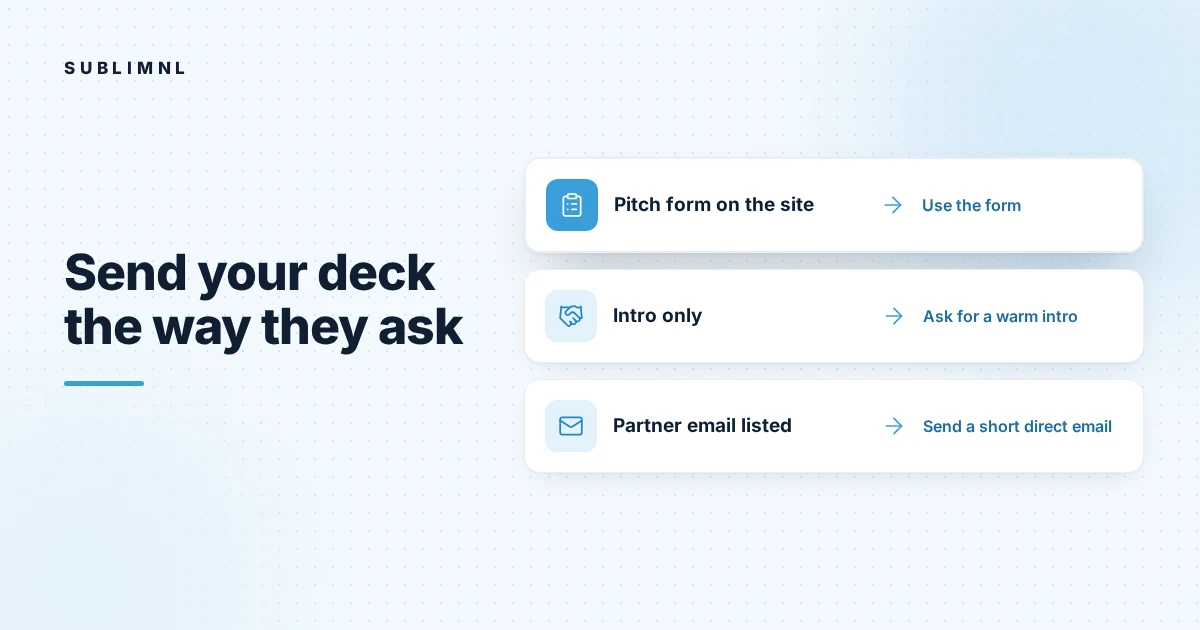
Every firm tells you, somewhere, how it wants to hear from founders. Some have a "pitch us" form. Some only take introductions. Some list a partner's email. If you've searched for how to submit pitch deck to VC firms, the most useful answer is also the least exciting one: find out how each firm wants to be reached, and do it that way.
Our guide on finding investors for your startup says it in five words: some firms only take decks through a form. Respect it.
Treat the channel as part of the fit check
When you research a firm, you already check its portfolio, stage, check size and the partner for your sector. Add one more column: how they want to be reached.
It's not just etiquette. A firm that asks for decks through a form has built a process around it. Emails that go around the form may not reach the people who review submissions. A firm that says it only takes introductions is telling you where its attention goes. Our post on what to read on a VC firm's website covers where to look for this on the site.
The three common channels

| What the firm says | What it usually means | What to do |
|---|---|---|
| A "pitch us" form | They review submissions through a set process | Fill in the form carefully |
| Introductions only | They mainly meet founders through people they know | Find a warm path, or move on |
| A named email address | They're open to direct email | Send a short, specific email |
Many firms combine these. A firm might accept forms but say introductions are welcome too. When that's the case, an introduction is usually the stronger route if you can get one.
Pitch forms: how to submit pitch deck to VC firms well
Forms feel impersonal, so founders tend to rush them. Don't. Someone reads what you write, and a form is often read more systematically than a cold email.
Answer the question they asked
If a field says "What does your company do?", answer in one plain sentence. Don't paste your mission statement. If it asks for traction, give your real numbers and nothing else.
Keep the same structure as a good email
The pieces that make a good first email work in a form too: what you do, one line of real proof, the ask, and the deck. If there's a free-text box, use it for the "why this firm" line: a company they backed or a thesis they've stated.
Make the deck easy to open
Use a link that works without a login, or the file format they ask for. Check it in a private browser window before you submit.
Note the date
Write down when you submitted. If you're sending to all your investors in one window, submit forms on the same day as your emails so your timeline stays consistent.
Intro-only firms
When a firm says it only takes introductions, believe it. Cold emails to partners at those firms tend to go unanswered, and that's not a judgment on your company.
Look for a path. Founders the firm has backed are a natural one, and so are angels who co-invest with them. Write the request so the connector can forward it unchanged and decline easily. Our post on asking for a warm introduction walks through it.
If you can't find a path, leave the firm off this round. A cold email that ignores their stated process uses up a first impression you might want later.
When a firm lists an email
Then email them. Keep it short: a specific subject line, one line on what you do, one of proof, the ask, and the deck, with the first slides in the email if you can. Send one email per investor with only their address in the To line.
What not to do
- Don't submit the form and also email three partners. It reads as impatience.
- Don't message partners on every channel at once.
- Don't resubmit the same form repeatedly because you haven't heard back.
One clear submission, in the place they asked for, is the respectful version. It's also usually the effective one.
FAQ
Is a VC pitch submission form a waste of time?
No. Firms that publish a form generally review what comes through it. It's a lower-odds channel than a warm introduction, but it's the one they asked for, so it's better than going around it.
Can I email a partner after submitting the form?
Only if you have a real reason, such as an introduction from someone they know or genuinely new news. Otherwise, give the process time.
What if a firm doesn't say how to reach them?
Look for a partner who covers your sector and send them a short, specific email. If you can find a warm path, use that first.