
BlogResearch
Start with the VC portfolio: research a firm in five minutes
You've got a name on your list. Maybe it came from a funding announcement, a friend's suggestion or a database. Before you write a word to them, spend five minutes on the firm's own site. That's most of how to research a VC firm well, and the VC portfolio is where to start. It's also the step founders skip when they're in a hurry.
Our guide on finding investors for your startup is direct about why: the firm's own words beat any database field. A database can be out of date. A firm's site is what the firm currently says about itself.
How to research a VC firm: the five-minute checklist
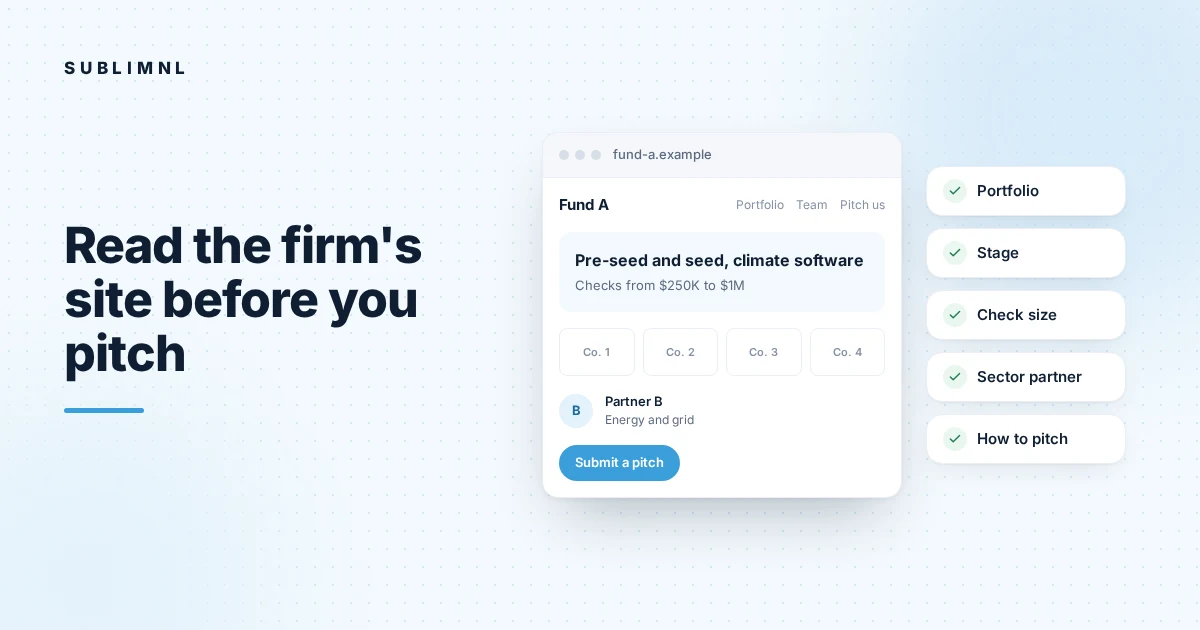
Open the site and look for five things, in this order.
- The portfolio. Who have they backed, and recently?
- The stated stage. Do they say when they invest?
- The check size. Do they say how much they usually put in?
- The partner for your sector. Is there one person who covers what you do?
- How to submit. Is there a "pitch us" form, or do they ask for introductions?
If the firm fails the first three, you're done. Take it off the list and move on.
The VC portfolio: the most honest page on the site

Start here, because it's the firm's actual record rather than its marketing. Look for companies close to yours in sector and stage. Look at how recent they are. A firm whose newest companies in your space are several years old may have moved on.
Also notice what's missing. If a firm backs a lot of consumer companies and you're selling compliance software to hospitals, the portfolio is telling you something even if the homepage says "sector agnostic."
Stage and check size
Many firms state their stage on the site: pre-seed, seed, Series A, or a range. Take it seriously. A fund that says it invests at Series A is unlikely to lead your pre-seed round, however good the meeting.
Check size works the same way. If a firm's stated check is far larger than your whole round, or far smaller than you need from a lead, the fit is off. Note what you find in your list so you can see it later.
If neither is stated, the portfolio is your next best clue. Look at the stage companies were at when the firm first invested.
The partner who covers your sector
At most firms, one partner usually covers your sector. Team pages often say who focuses on what. If they don't, read partner bios and look at which partner sits on the boards of companies like yours.
This is who you'll write to. The firm is a logo. The partner is a person with specific interests, and their posts and past investments tell you what your first line should be about.
How they want to be reached
Some firms have a "pitch us" page with a form. Some say they only take introductions. Some list an email address. Whatever they say, follow it. Some firms only take decks through a form, and sending around it rarely helps. Our post on submitting a pitch deck to a VC covers how to fill in those forms well.
When the site and a database disagree
They will, often. A database might list a firm as active at seed while its site says it now focuses on later rounds. Trust the site. A lot of databases are big but rarely checked, so treat their fields as leads to confirm. Our post on whether investor databases are worth paying for goes into when a list is worth it.
One more check: is the firm investing right now?
A firm can tick every box and still not be writing new checks. A firm that raised a new fund recently is actively writing checks, so look for a fund announcement on the site's news page. Recent portfolio additions are a good sign too. Sublimnl builds its own list from SEC Form D filings, updates it every week, and shows you the investors who backed companies like yours in the last two years, with the filing and the public announcement behind each deal. It's included with every Sublimnl plan.
Turning the research into an email
Five minutes on the site gives you most of a good first email. You know the firm fits your stage and sector, which partner to write to, and how they want to receive it. You can also write a "why you" line that points to something real: a company they backed or a thesis they state. That one line does more than any amount of polish elsewhere.
FAQ
What if a VC firm's website doesn't list a stage or check size?
Look at the portfolio and note what stage companies were at when the firm first invested. Funding announcements for those companies often say which round it was.
Should I email a partner directly if the firm has a pitch form?
Use the form if the firm asks for it. Some firms only take decks that way. A warm introduction to the right partner is the other route worth trying.
How recent should the deals in a VC portfolio be?
The more recent, the better, at least for companies in your sector. A firm whose last deal in your space was years ago may have shifted focus, so look for activity in the last year or two.