
BlogResearch
New venture capital funds, and how to tell who's still writing checks
A firm can match your stage, your sector and your region, and still say no for a reason that has nothing to do with you: it isn't making new investments. That's why it helps to look for new venture capital funds, and for firms that are visibly deploying, before you spend a warm introduction on them.
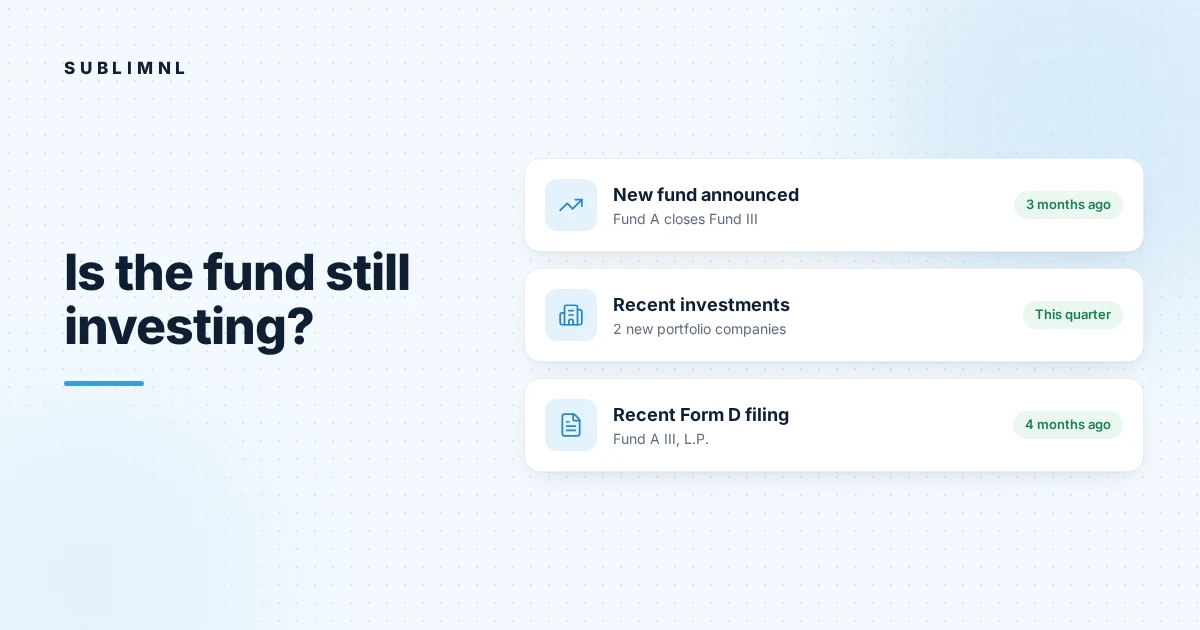
Our guide on finding investors for your startup puts the rule simply: a firm that raised a new fund recently is actively writing checks. This post covers how to spot that, and a few other signals worth checking.
Why timing inside a fund matters
Venture firms raise money in funds. Each fund is invested over a period of years, first into new companies and later mostly into follow-on rounds for companies already in the portfolio. The uninvested money a firm still has is often called dry powder.
You don't need to know a fund's exact numbers. You just need a rough sense of whether the firm is in the part of its cycle where it backs new companies. A firm near the end of a fund may still take meetings and still be friendly. It may also be saving its remaining money for companies it already owns.
Signal 1: A recent fund announcement

The clearest signal is a firm saying it has raised a new fund. Funds announce new raises, usually on their own news page or blog, and often through the partners' own posts.
When you find one, note the date and read what the firm says the fund is for. Announcements often describe stage, sector and geography, which doubles as a fit check. A new fund focused on seed-stage climate software is telling you more than any database field could.
Signal 2: Recent new investments
A fund announcement isn't the only sign. Look at the firm's portfolio page and at recent funding announcements that name it. Are new companies being added? Is the firm leading first rounds, or only showing up in follow-ons?
A steady flow of new first checks in the last several months is a strong sign the firm is open for business. A portfolio that hasn't changed in a long time is worth a closer look before you invest your time.
Signal 3: New-fund filings with the SEC
Many US funds file a Form D with the SEC when they raise, which you can search on EDGAR. A Form D is a notice of an exempt offering, and a venture fund raising money from its own investors will often file one. That gives you a public, dated record that a fund is raising.
It's not a complete picture. Not every fund files, filings don't tell you a firm's strategy, and you shouldn't treat the amounts on the form as a precise fund size. But as a timing signal, it's useful. Our step-by-step on searching SEC Form D filings walks through how to find and read them.
Putting the signals together
No single signal is decisive. Read them together:
- Strong: a recent new fund, plus recent first checks in your sector.
- Good: recent first checks, even without a fund announcement you can find.
- Check before you spend effort: no recent fund news and few new investments.
- Probably not now: activity limited to follow-on rounds for existing companies.
None of this means cutting a firm forever. It means ordering your effort. Put the firms that are clearly investing at the top, where your warm introductions and best "why you" lines go.
Tracking new venture capital funds: a shortcut Sublimnl includes
Tracking fund announcements and filings by hand works, but it's slow. Sublimnl builds its own list from SEC Form D filings, updates it every week, and shows you the investors who backed companies like yours in the last two years, with the filing and the public announcement behind each deal. It's included with every Sublimnl plan. The manual method above is the same one the list is based on, and you can still use it to check a filing yourself.
How to use this in your outreach
A firm that just raised a new fund is often meeting a lot of founders, and its partners may be writing publicly about what the new fund is for. Read that. If the announcement or a partner's post describes the kind of company you're building, your first line can say so. Keep it factual: what they said, and why your company fits it.
FAQ
What is dry powder in venture capital?
It's a common name for the money a firm has raised but not yet invested. Firms with more of it are generally better placed to back new companies.
Does a new fund mean a firm will invest in my company?
No. It means the firm is likely writing new checks. It still has to fit your stage, sector and region, and the partner still has to like the company.
Where can I see if a VC firm raised a new fund?
Check the firm's own news page and partners' posts first. For US funds, you can also search for the fund's Form D filing on the SEC's EDGAR system.