
BlogFilings
SEC Form D search: find venture funds that just raised
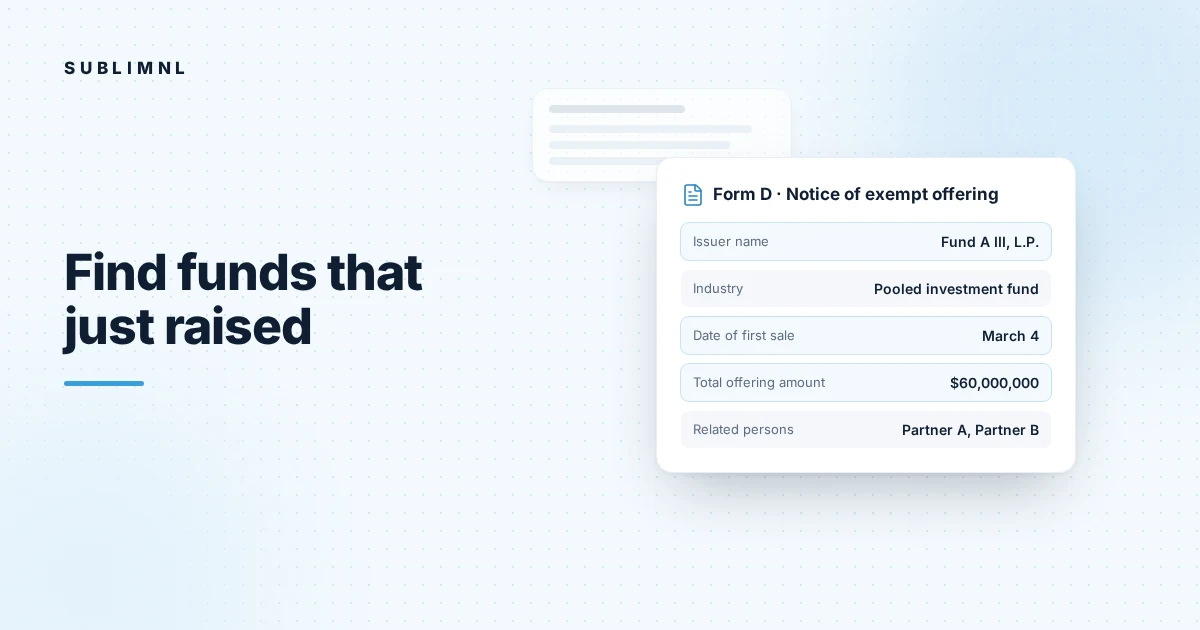
Most founders never open EDGAR, the SEC's public filing system. It looks built for lawyers, and parts of it are. But one small corner is useful for fundraising: an SEC Form D search can show you which venture funds have recently been raising money, and the SEC's EDGAR full text search is a straightforward way to run one. A firm that raised a new fund recently is actively writing checks, as our guide on finding investors for your startup puts it.
This post covers what a Form D is, how to find one, what it does and doesn't tell you, and how to turn a filing into a name on your list.
What an SEC Form D is
According to the SEC, Form D is a notice of an exempt offering of securities. Companies that sell securities without registering them, under Rule 504 or Rule 506 of Regulation D, have to file it. The SEC says the notice is due within 15 days after the first sale, and it has to be filed online through EDGAR.
Venture funds raise money from their own investors through private offerings, so many US funds file a Form D when they raise. That's what makes the filing useful to you: it's a public, dated record that a fund is raising.
What the form shows

The form itself is short. The parts that matter for your research:
- The issuer. The fund's legal name. Funds often file under a name that includes the firm's name and a fund number.
- Principal place of business. Where the issuer is based, with contact details.
- Related persons. The SEC asks for executive officers, directors and promoters. For a fund, these names can point you toward the firm's people.
- Industry group. If the issuer picks "Pooled Investment Fund," it also chooses a fund type, and one option is "Venture Capital Fund."
- New notice or amendment. Whether this is the first filing for the offering or an update.
- Offering and sales amounts. The total offered and the amount sold so far. The form allows "Indefinite" when the amount can't be determined.
What it doesn't show
A Form D is a notice, not a strategy document. It won't tell you what stage the fund invests in, which sectors it likes, or which partner covers your space. Not every fund files one, and funds outside the US usually won't appear.
Be careful with the amounts. They reflect the offering as reported on the form, which can be indefinite or updated by later amendments. Don't read them as the fund's final size, and don't put a number in your outreach based on one.
Using EDGAR full text search to find Form D filings
You don't need an account, and you don't need to master the tool. The general approach:
- Use EDGAR full text search and filter by form type D. That limits the results to Form D notices and their amendments.
- Search by name or by phrase. If a firm is already on your list, search for its name. Funds often file under their own legal name, which may not match the brand on the firm's website, so try a few variations. To find funds you haven't heard of, search for a phrase that appears on the form itself, such as "Venture Capital Fund," the fund type a venture fund can select.
- Limit the dates. The search lets you set a filed-from and filed-to range. Recent filings are the ones that matter for timing.
- Read the filing itself. Check the fund type, the filing date, where the issuer is based, and whether it's a new notice or an amendment.
We checked these options against the live EDGAR full text search in October 2026. The SEC can change the page, so if a label has moved, look for the same option under a different name.
You can also work the other way, searching recent Form D filings and looking for venture funds you haven't heard of. That takes longer, and most results won't fit you, so treat it as a way to find candidates rather than a finished list.
Reading the results with care
A phrase search returns more than venture funds. Many kinds of pooled vehicles file a Form D, and so do entities set up for a single deal. Open each filing and check the fund type before a name goes anywhere near your list.
A few other habits help:
- Treat amendments carefully. An amendment can mean a fund is still raising, or simply that it updated its details. One amendment on its own tells you little.
- Use the address as a first clue, not a verdict. Where the issuer is based is a quick first check on region, but an address isn't an investment mandate. Confirm geography on the firm's own site.
- Expect some dead ends. Some fund names won't lead you to a firm you can identify easily. Move on rather than guessing.
From a filing to a partner
A filing gets you a fund name and a date. Now do the same research you'd do for any firm:
- Find the firm's own website from the fund name.
- Read its portfolio, stated stage and check size.
- Look for an announcement of the new fund, which often says what it's for.
- Find the partner who covers your sector.
- Note how the firm wants to be reached.
If the firm fails the fit check on stage, sector or region, it comes off the list, new fund or not. Our post on telling whether a VC fund is actively investing covers the other signals to read alongside a filing.
A simpler route
Running these searches every few weeks is useful but tedious. Sublimnl builds its own list from SEC Form D filings, updates it every week, and shows you the investors who backed companies like yours in the last two years, with the filing and the public announcement behind each deal. It's included with every Sublimnl plan. The manual routine above still works when you want to check a filing yourself.
FAQ
Is SEC Form D information public?
Yes. Form D notices are filed on EDGAR, and anyone can search and read them without an account.
Does every venture fund file a Form D?
No. Many US funds file one when they raise, but not all do, and funds outside the US usually won't appear. Treat a filing as one signal among several.
Can I tell a fund's size from its Form D?
Not reliably. The form reports offering and sales amounts, which can be indefinite or change in later amendments. Use it as a timing signal, not a size estimate.