
BlogThe list
What is a lead investor? Who leads at pre-seed and seed
If you're raising for the first time, "what is a lead investor" sounds like a vocabulary question. It's really a planning question. The lead is the investor who commits first and gives everyone else a reason to say yes. Without one, a round can collect a lot of warm interest and still not close.
This post covers what a lead does, who tends to lead at pre-seed and at seed, and how to make sure your list is built around investors who actually lead at your stage.
What is a lead investor, in plain terms
A lead investor is the first serious commitment in a round. They usually write one of the larger checks, and in a priced round they typically negotiate the terms that the other investors then sign up to.
Just as important, they're the signal. Other investors often wait to see who else is in. Once a credible lead commits, the conversation with everyone else changes from "maybe later" to "how much room is left?"
Follow-on investors are the rest of the round. They're valuable, and plenty of good investors prefer that role. But a round made only of followers is a round still waiting for someone to go first.
Lead vs follow-on investor: why the difference matters for your list

When you build a list, it's easy to treat every investor as interchangeable. They're not. Some firms lead at your stage. Some join rounds others lead. Some don't invest at your stage at all.
Our guide on finding investors for your startup puts it bluntly: a long list of firms that don't lead your stage is just a longer list of no's. You can have great meetings with followers, and each of them can still say, kindly, "come back when you have a lead."
So "who leads" is one of the four lines worth writing down before you add any names. The others are your round and size, your sector in one phrase, and where you are. Our post on building an investor list walks through all four.
Who leads at pre-seed
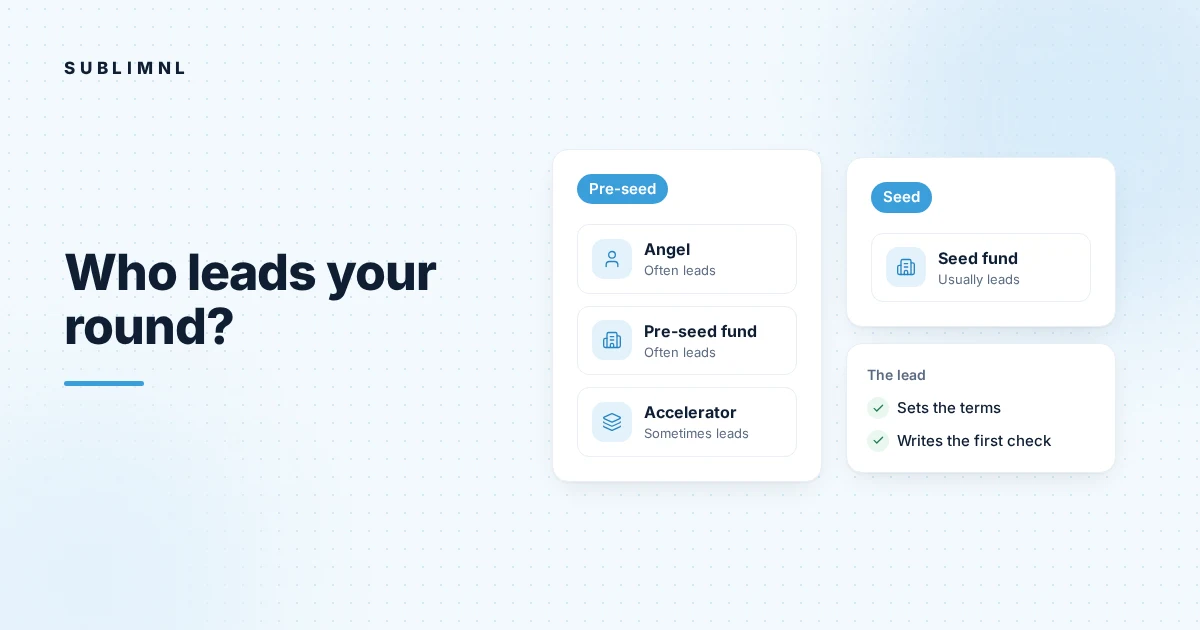
At pre-seed, the lead is often an angel, a pre-seed fund or an accelerator.
- Angels. Especially operators from your industry and founders who raised recently. They understand the problem fast and can move without a committee.
- Pre-seed and early seed funds. They write first checks and sometimes lead.
- Accelerators. They invest a set amount on standard terms and add a network. For some companies, that's the anchor the rest of the round forms around.
Pre-seed rounds are often raised on a SAFE or convertible note, so "leading" can be less formal than in a priced round. There may be no long negotiation over terms. But the role is the same: someone commits first, and others feel comfortable following.
One trap is worth knowing. Seed funds sometimes write pre-seed checks, but many won't lead one. Check each firm's stated stage before it goes on your list. Our pre-seed guide covers who invests at this stage in more detail.
Who leads a seed round
At seed, the lead is usually a fund. Angels still participate, and some write meaningful checks, but the anchor of a seed round is typically an institutional investor.
That changes how you research. A fund that has led seed rounds in your sector recently is a much stronger name than one that has only joined them. Funding announcements usually say who led, and that's the detail to write down.
How to tell whether a firm leads at your stage
You don't need a paid tool for this. You need a little patience.
- Work backward from companies like yours. Look for startups in your sector that closed a round like yours recently, and write down which investor led each one. Funding announcements and the companies' own news pages name the lead.
- Read the firm's own site. Check the portfolio, the stated stage and the check size. The firm's own words beat any database field.
- Look at the pattern, not one deal. A single lead at your stage is a data point. Several in your sector is a habit.
If a firm keeps showing up as a participant but never as the lead, it may still belong on your list. Just don't count on it to start your round.
What this means for your outreach
Order your effort. Put the investors most likely to lead at the top, and spend your warm introductions on them first. Followers matter too, but they tend to move once there's momentum, so send to everyone in one tight window rather than one at a time over months. Investors talk to each other, and a round that feels active gets more attention than one that drifts.
When you write to a likely lead, make the fit obvious. Say what you do in one line, give one line of real proof, state the round, and say why them: a company they backed, a post they wrote, the thesis on their site.
FAQ
Do I need a lead investor to close a round?
Not always, especially at pre-seed on a SAFE, where a group of angels can fill a round together. But someone usually has to commit first before the others move, and that person is your lead in practice even if no one uses the word.
Can an angel be the lead investor?
Yes. At pre-seed, an angel is often the lead, particularly an operator from your industry or a founder who raised recently. At seed, a fund usually leads.
How do I find out who led a startup's round?
Read the funding announcement and the company's own news page. Those usually name the lead investor, and often the partner who did the deal.