
BlogThe list
How to build an investor list: write four lines first
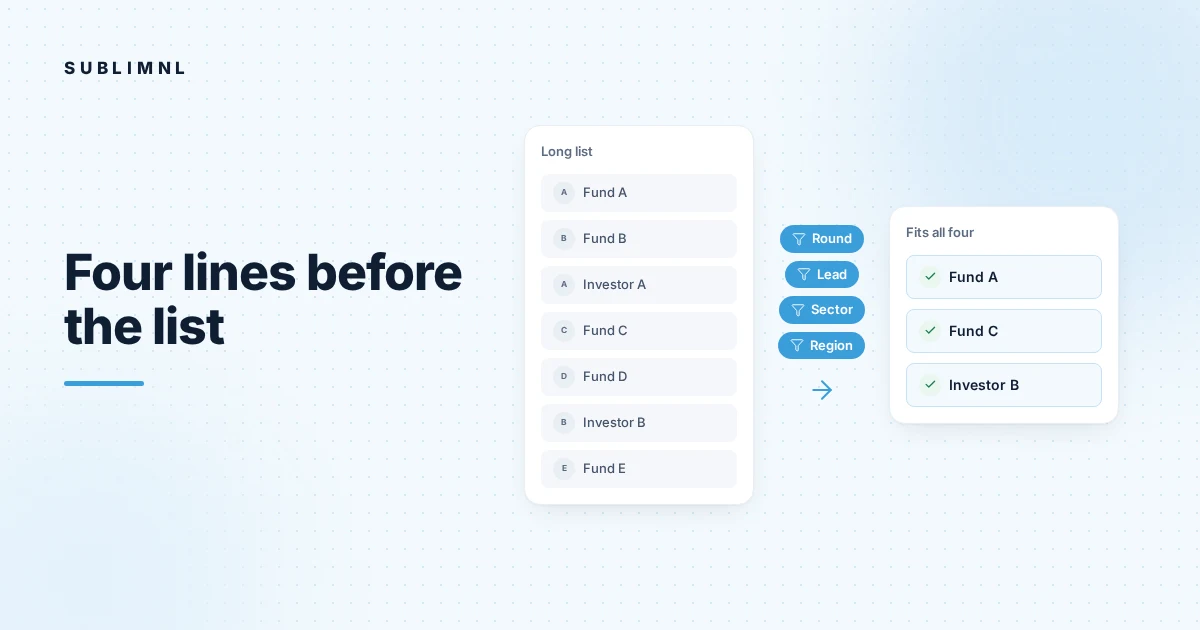
Most founders learn how to build an investor list the slow way. They open a spreadsheet, paste in every name that looks roughly relevant, and end up with hundreds of rows. Then the replies come back, or don't, and it turns out much of the list was never going to invest in a company like theirs.
There's a better order. Before you add a single name, write four lines about your round. Those lines become the filter every investor has to pass. Our guide on finding investors for your startup opens with the same step, for good reason.
The four lines
Write them down before you open a database or a single firm's website.
- Round and size. Pre-seed, seed or Series A, and roughly how much you're raising.
- Who leads. At pre-seed that's often an angel, a pre-seed fund or an accelerator. At seed, usually a fund.
- Your sector in one phrase. Use the phrase an investor would put on their own thesis page.
- Where you are. Some funds only invest in certain countries or regions.
That's the whole exercise. It's short to write, and it saves you a lot of email that was never going to land.
Why the four lines work as a filter

The rule is simple. Every investor on your list should match all four lines. Not three. All four.
It sounds strict, and it is. But think about what a near miss means in practice. A fund that doesn't write checks at your stage won't lead your round, however good the deck. A fund with a clear thesis in a different sector will pass politely. A fund that only invests in another region may not be able to invest at all.
A long list of firms that don't lead your stage is just a longer list of no's. Each one costs you an email, a follow-up and a little morale in the middle of a raise, which is exactly when you can least afford it.
Line by line: what to watch for
Round and size
Be honest about your stage. If you have a working demo and a few pilots, you're probably raising pre-seed, even if "seed" sounds better in conversation. The amount matters too, because a firm's stated check size tells you quickly whether your round is the kind they write.
Who leads
This is the line founders skip most often, and it does the most work. Plenty of investors will join a round. Far fewer will lead one, which means committing first and usually setting the terms others follow. A list made mostly of followers can produce a lot of friendly interest and still no round. We go into this in who leads at pre-seed and seed.
Your sector in one phrase
Write the phrase an investor would use, not the one from your homepage. "Software for independent pharmacies" is easier to match than a stack of buzzwords. If a firm describes its focus as "vertical software" and that's what you build, use their words.
Where you are
Check geography before a name goes on the list, not after a polite no. Some funds state it plainly. With others you'll have to look at where their portfolio companies are based.
How to build an investor list from the four lines
Once the lines are written, the research gets faster because you know what you're looking for.
Start from companies like yours. Find startups in your sector that raised the round you're raising in the last year or two, and note who led. Funding announcements and the companies' own news pages usually name the lead. Those investors have already shown they back your stage and your sector.
Then read each firm's own site. Check the portfolio, the stated stage and check size, and whether there's a partner who covers your sector. The firm's own words beat any database field.
Keep a column for each of the four lines in your sheet, and mark every name against them. When a name fails one, it comes off, and you can see exactly why. Our post on cutting wrong-fit investors covers how to make those calls without second-guessing every one.
A shorter list where every name fits is easier to work properly. You can look for a warm path to more of them, write a real "why you" line for each, and send to all of them in one tight window instead of letting the raise drift over months.
Where Sublimnl fits
Sublimnl is a fundraising outreach tool for founders. It handles the part between having a list and getting meetings: your deck lands in each investor's inbox with the first slides in the email, and you see what each one read. You still choose who to contact, and the four lines are the best place to start.
Sublimnl builds its own list from SEC Form D filings, updates it every week, and shows you the investors who backed companies like yours in the last two years, with the filing and the public announcement behind each deal. It's included with every Sublimnl plan. A firm that raised a new fund recently is actively writing checks, which makes it worth checking against your four lines.
You still choose every investor before anything is sent.
FAQ
How many investors should be on my list?
Enough that a handful of no's doesn't end the round. Fit matters more than volume. A list where every name leads your stage in your sector beats a longer list of firms that don't.
Can I use an investor database to build the list?
Only if the list is fresh and you can see why each investor is on it. A lot of databases are big but rarely checked. Sublimnl builds its own list from SEC Form D filings, updates it every week, and shows you the investors who backed companies like yours in the last two years, with the filing and the public announcement behind each deal. It's included with every Sublimnl plan. Confirm stage, sector and contact on the firm's own site before you send.
What if an investor matches three of the four lines?
Leave them off your main list. If you can't bear to cut them, keep them in a separate tab and come back once your round has a lead. Then they may fit as a follower.