
BlogResearch
Which venture capital partner to pitch, and how to write your first line
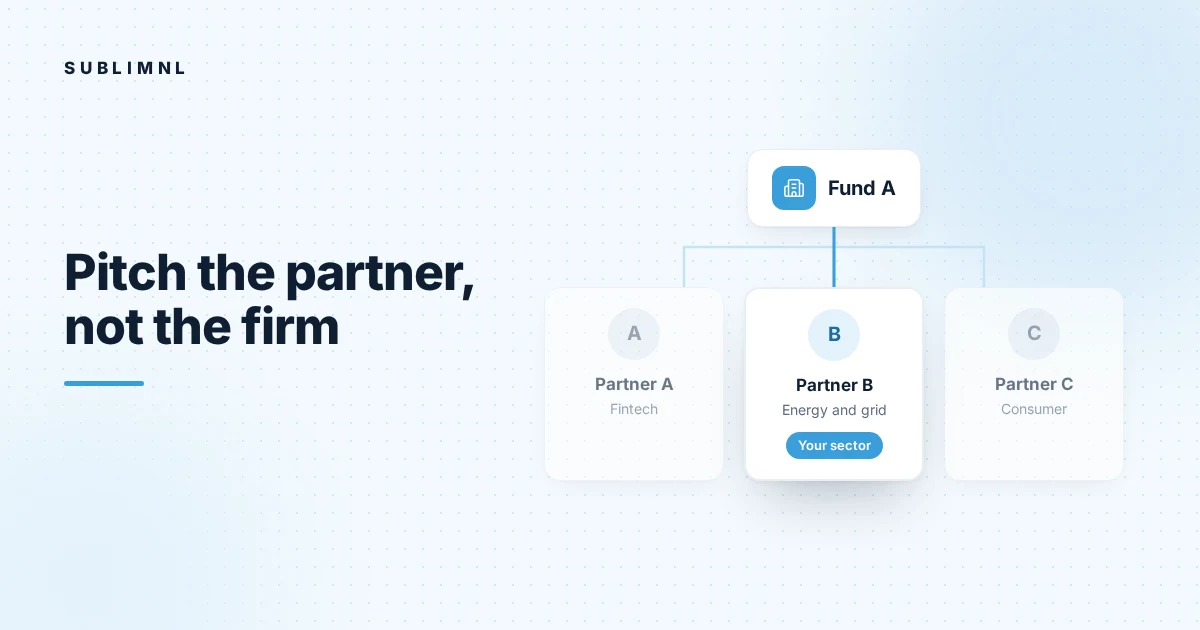
A firm doesn't read your email. A person does. Founders often spend hours deciding which firms belong on their list and seconds deciding which venture capital partner to pitch, then send to a general inbox or whichever name came up first. That's backwards.
At most firms, one partner usually covers your sector. Their posts, talks and past investments tell you what they care about, and that's what your first line should be about. It's step four in our guide on finding investors for your startup, and it's the one that turns a decent email into a relevant one.
Why the partner matters more than the logo
Inside a firm, partners tend to specialize. One might focus on developer tools, another on healthcare, another on marketplaces. When your deck lands with the wrong one, the best case is that they forward it. The more common case is that it sits, because it isn't their area and they have plenty in their own.
The right partner reads your email with context. They already understand the market, they've likely met your competitors, and they can tell quickly whether you're onto something. That's an advantage for you, even when it means tougher questions.
How to find the right venture capital partner

Start on the firm's own site, then widen out.
The team page
Many firms list each partner's focus areas. If yours is named, you're nearly done. If the page is vague, keep going.
Board seats and past deals
Look at the portfolio and note which partner led or sits on the board of companies close to yours. Funding announcements often name the partner who did the deal. If the same name keeps appearing next to companies in your space, that's your person.
Their own writing and talks
Partners who write or speak publicly are giving you a map. Read their recent posts. Watch a talk if there is one. You're looking for the problems they return to, the opinions they hold firmly, and the kinds of companies they say they want to see.
When two partners could fit
Pick the one whose recent deals look most like you. If it's genuinely close, pick one anyway. Writing to two partners at the same firm at once tends to look like you didn't do the work.
Turn what they've said into your first line
This is where the research pays off. Your first line should connect something real about the partner to something real about your company. Not flattery. A link.
Take a fictional example. A partner has written several times about how small manufacturers still run quality checks on paper. You're building inspection software for contract manufacturers. A first line that works:
"You've written about quality checks still running on paper at small manufacturers. That's the problem we're solving for contract manufacturers."
It's short, it's checkable, and it tells the partner in one sentence why the email is in their inbox. Compare that with "I've long admired your firm's portfolio," which could be sent to anyone.
A few rules keep it honest:
- Point to something specific. A post, a talk, a company they backed, their stated thesis.
- Make it true. If the connection is a stretch, don't force it. A weak link reads worse than none.
- Keep it to one line. The rest of the email is about your company.
Fit the rest of the email around it
Once the first line is done, the rest follows a simple pattern: one line on what you do, one line of real proof, the ask, and the deck. Our guide with templates for emailing investors has copy-ready versions, and our post on how to email investors breaks down each part.
The "why you" line is the one a template can't write for you. Everything else can be reused. That line has to be written fresh for each partner, and it's worth the time.
When you can get an introduction
If someone you know can introduce you to the right partner, ask for that first. Most venture deals reach investors through someone they know. Your research still matters: tell the connector exactly which partner and why, so the introduction lands in the right place.
FAQ
Can I pitch more than one venture capital partner at the same firm?
It's better not to at the same time. Pick the partner whose recent deals and writing are closest to your company. If they pass, ask whether a colleague might be a better fit.
What if the partner who covers my sector doesn't write publicly?
Use their past investments and board seats instead. The companies they've backed tell you a lot about what they look for.
Should I mention a partner's post in my first email?
Yes, if it's genuinely relevant and you can say why in one line. Point to the idea, not just the fact that you read it.