
BlogEmail
How to email investors: four parts, and nothing else
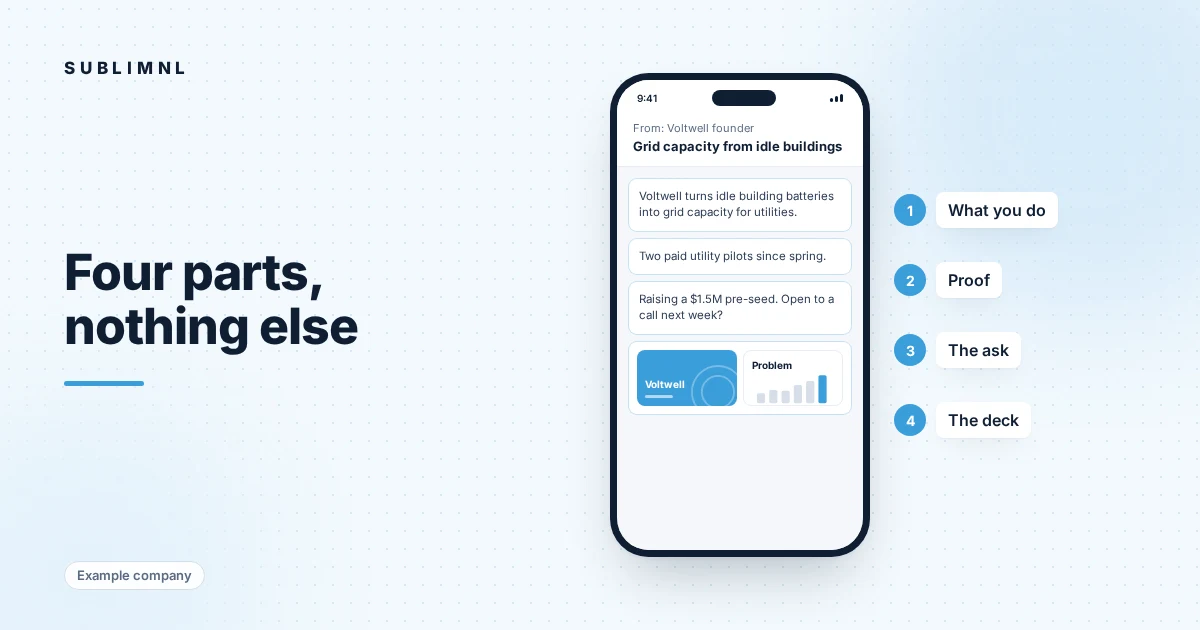
Most first emails to investors are too long, and that's the first thing to fix if you're working out how to email investors. They open with a paragraph of background, explain the vision, list the team's credentials, describe the market size, and finally, near the bottom, mention a round. By then the investor has moved on.
So start with what to leave out. Our guide on finding investors for your startup puts the whole first email in one line: one line on what you do, one line of proof, the ask, and the deck.
How to email investors who read on a phone
Investors often read email on a phone, between meetings. A first email has one job: get them to open the deck or reply. Everything that doesn't serve that job slows it down.
Our guide with templates for emailing investors suggests keeping it under about 120 words. That's three to five sentences, plus the deck. Short enough to read in under a minute.
Part 1: What you do, in one line

Say what the company does and who it's for, in plain words. Not your mission. Not your category. What a customer pays you for.
"We help independent veterinary clinics handle insurance claims without a dedicated billing person."
One sentence, no jargon, and an investor knows within seconds whether this is their area. If you need two sentences to explain what you do, keep working on it before you send anything.
A quick test: read the line to someone outside your industry. If they can repeat back what you do and who pays for it, it's ready. If they ask "so what is it, exactly?", it isn't.
Part 2: One line of proof
Pick your single strongest real fact. Users, revenue, pilots, a signed letter of intent, a working product with active customers. Only numbers you can back up, and never rounded up.
If your proof is early, say what it is plainly. A pilot is a pilot. An investor would rather see a modest true number than a vague claim.
What to cut here: a list of every metric you track. One line. The rest belongs in the deck.
Part 3: The ask
State the amount, the round and the instrument. "We're raising a pre-seed round on a SAFE." Add what the money gets you to if you can say it in a phrase.
Founders sometimes leave the ask out, hoping to "start a conversation" first. That makes the investor guess. Tell them.
The ask also helps the investor sort you. A firm that writes seed checks will read a pre-seed ask differently from a seed one, and that's useful. If the ask doesn't match what they do, you'd rather find out now than after three meetings.
Part 4: The deck
Include the deck, ideally with the first slides visible in the email itself, so the investor can judge the pitch without clicking. A link lets you update it and see whether it was read. An attachment is easier for some investors but can't be tracked. Either way, showing the opening slides inline gives them the gist.
The line that holds it together: why them
Inside those four parts, add one line on why you're writing to this investor in particular. A company they backed, a post they wrote, their stated thesis. No template can write it, and it's the clearest sign that this email was written for them.
The subject line
Before any of this gets read, the subject line has to earn the open. Say what you do, for whom, and one proof point, in plain words. Avoid vague hooks. Our post on writing an investor email subject line covers the pattern.
What to leave out
- Background and backstory. Save it for the meeting.
- Market size claims. They're in the deck if they matter.
- Team bios. One phrase at most, if it's directly relevant.
- Attachments beyond the deck.
- Several asks at once. One clear ask.
- Flattery. "I've long admired your firm" adds nothing. A specific reason adds a lot.
A few sending rules
Send one email per investor, with only their address in the To line. No CC, no BCC, no group sends. Include a one-line way to say "no thanks," and if you're sending as a business, your postal address. Send on a weekday, Tuesday to Thursday by convention.
FAQ
How long should an investor email be?
About three to five sentences, plus the deck. Short enough to read on a phone in under a minute, and under about 120 words.
Should my first email to a VC include the deck?
Yes. Include the deck, ideally with the first slides visible in the email. Making the investor ask for it adds a step that many won't take.
Can I use the same email for every investor?
Use the same structure, but write the "why you" line for each investor. An investor can tell when they're one of hundreds of recipients.