
BlogEmail
The pitch email subject line: say what you do, for whom, with proof
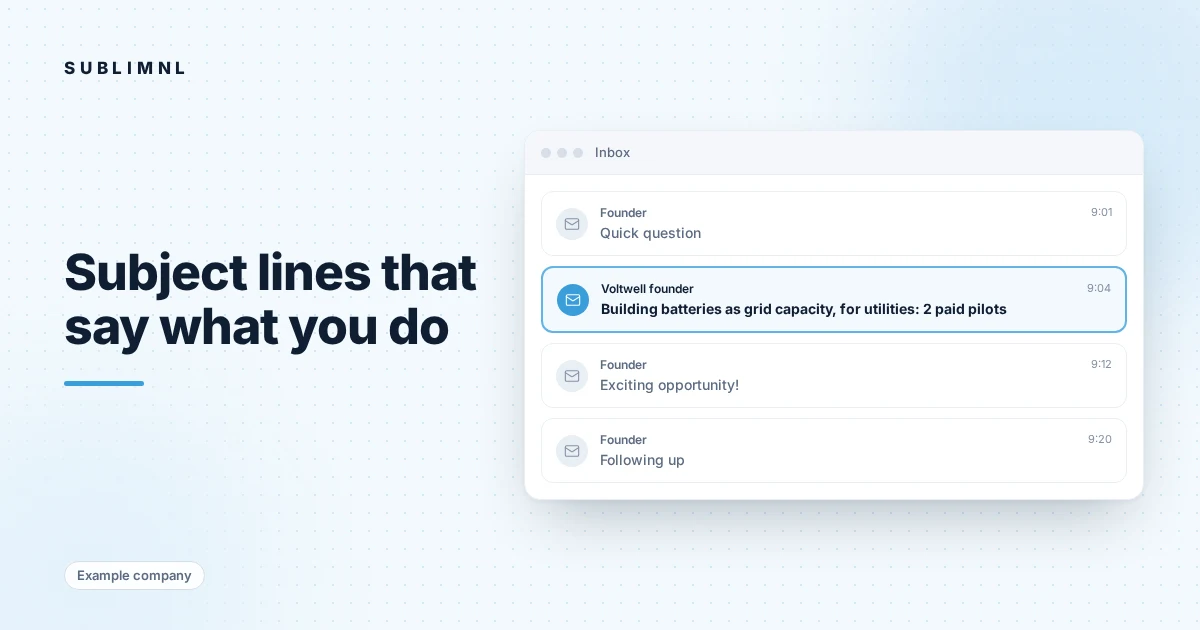
An investor's inbox is a list of subject lines. Before anyone reads your first sentence, your pitch email subject line has already decided whether they open it now, later, or never. Most founders polish the email and rush the subject. It's worth flipping that.
Our guide with templates for emailing investors gives a simple pattern: say what the company does and one proof point in plain words. Avoid vague hooks like "Exciting opportunity."
The investor email subject line pattern
Here's the shape:
[What you do, in plain words] for [who it's for]: [one proof point]
It does three jobs. It tells the investor what the company is before they open it. It tells them whether it's in their area. And it gives them one reason to believe it's real.
Why vague hooks fail

Subject lines like "Exciting opportunity," "Quick question" or "Changing the future of work" are trying to create curiosity. With investors, they mostly create work. The reader has to open the email just to find out whether it's relevant, and many won't bother.
A clear subject line respects their time. It also filters in your favor: the investors who open it are the ones who already see a possible fit.
There's a trust cost as well. A subject line that sounds like marketing makes the email look like marketing, and investors learn to skim past those. A plain one reads like a note from a founder, which is what it is.
Before and after
These examples use fictional companies.
Before: "Exciting opportunity in agtech" After: "Soil moisture sensors for vineyard managers: running on pilot farms"
Before: "Quick intro" After: "Bookkeeping for independent dental practices: paying customers across several states"
Before: "The future of logistics" After: "Dock scheduling for regional warehouses: live with our first customers"
Before: "Re: our chat" After: "Translation memory for legal teams: signed letter of intent"
The "after" versions aren't clever. That's the point. An investor scanning a list can sort each one in a second.
Notice, too, that none of them mention fundraising. The subject line describes the company. The email makes the ask. Keeping those jobs separate makes both easier to write.
Writing your own pitch email subject line
Start with what you do
Use the same one-line description you'd put at the top of the email. Plain nouns and verbs. No category buzzwords.
Name who it's for
A specific customer makes the subject line far more useful. "for vineyard managers" tells the investor more than "for agriculture."
Add one real proof point
Pick your strongest true fact: paying customers, a live pilot, a signed letter of intent, a working product. Only numbers you can back up. If your proof is early, say so honestly rather than inflating it.
Keep it short enough to read in full
Long subject lines get cut off, especially on phones. Put the most important words first.
If you're stuck, write several versions and read them out loud. Pick the one a stranger would understand fastest, then cut any word that doesn't change the meaning. Most good subject lines come from cutting, not adding.
Check it on a phone
Send a test to yourself and look at it in your phone's inbox. If the customer or the proof point gets cut off, move it earlier or shorten the description.
A worked example from our homepage
The Sublimnl homepage uses a fictional example company called Voltwell, which turns the batteries already sitting in office buildings into power the grid can buy. Voltwell is not a real customer. A subject line in the pattern might read: "Idle building batteries into grid capacity for utilities: pilot buildings enrolled." It says what the company does, who it's for and that there's early proof, without asking the reader to guess.
What not to put in a subject line
- Hype words. "Revolutionary," "disruptive," "massive."
- Fake familiarity. "Re:" or "Following up" on a first email.
- Your round details alone. "Raising our seed round" says nothing about the company.
- Numbers you can't support.
The subject line sets up the email
A good subject line works because the email delivers on it. Once they open, the first line should say what you do, followed by one line of proof, the ask, why them, and the deck. Our post on how to email investors covers each part, and our guide on finding investors for your startup covers who should receive it.
FAQ
What's a good pitch email subject line for a VC?
Say what you do, who it's for and one real proof point, in plain words. For example: "[What you do] for [who]: [proof]."
Should I put my round size in the subject line?
It's not necessary. The subject line's job is to show what the company is and why it's credible. The ask belongs in the email.
Can I use the same subject line for every investor?
Usually, yes. The subject describes your company, which doesn't change. Personalize the "why you" line in the email itself.