
BlogIntroductions
How to ask founders for investor introductions without making it awkward
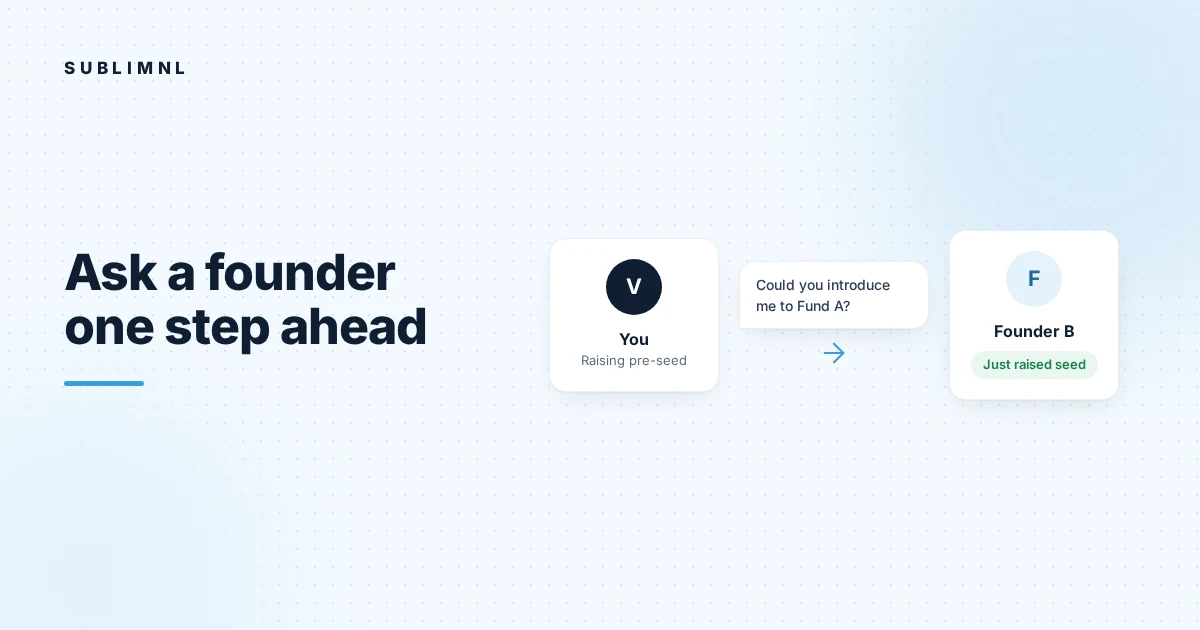
Founders a year or two ahead of you are some of the most useful people you can know while you raise. They've just been through it. They remember which investors were helpful and which weren't. They often angel-invest. And they can introduce you to their own investors. Knowing how to ask founders for investor introductions, without turning the relationship into a transaction, is one of the most practical skills in early fundraising.
Our guide on finding investors for your startup lists founders a little ahead of you as one of the best sources of angels. This post is about how to approach them.
Why founders who just raised are worth asking
A founder who raised recently has three things you need: fresh knowledge, a live relationship with investors, and credibility with those investors.
That last part matters. When a founder an investor has backed recommends another company, the investor tends to listen. Portfolio companies are a real deal source. In the survey of 885 VCs cited in our guide, 8% of deals came from portfolio companies, and over 30% came through investors' professional networks more broadly (NBER Digest summary).
Three different asks

Before you write, decide what you're asking for. It's usually one of three, and mixing them muddles the message.
- Advice. "How did you run your raise? Which investors were most useful?" This is the easiest yes and often the best place to start.
- An angel check. Many founders angel-invest after raising. Asking them directly is fine, as long as it's clear and easy to decline.
- An introduction to their investors. The most valuable ask, and the one that needs the most care, because they're spending their own credibility.
You can end up with all three from one person. Just don't ask for all three in the first message.
How to ask founders for investor introductions
Make it easy for them to judge the fit
A founder won't introduce you to their investor unless they think the fit is real. Tell them which investor, and why: the investor backs your stage, your sector, and companies like yours. If you've done the research, say so in a line.
Write a note they can forward unchanged
This is the single most helpful thing you can do. Write a short paragraph about your company that the founder can paste or forward without editing: what you do, one line of real proof, what you're raising. Our templates for emailing investors include a forwardable version you can adapt.
Make "no" easy
Say it plainly: "No worries if it's not a fit, or if now isn't a good time." A founder who feels free to say no is more likely to say yes when they mean it.
Let them check with the investor first
Many founders prefer to ask the investor whether they're open to the intro before connecting you. Encourage that. It protects the founder's relationship and means the investor is expecting you.
A sample note
Here's a fictional example, written so it can be forwarded as is:
"Would you be open to introducing me to Sam at the firm that backed you? They've led a few seed rounds in payroll software, and we build payroll for restaurant groups with hourly staff across several locations. Short version Sam can read: we run payroll for restaurant groups with shift-based staff. Several groups already run payroll on it. We're raising a seed round. Happy to send a deck first if that's easier, and no worries if it's not a fit."
Notice what it doesn't do. It doesn't oversell, it doesn't ask for three things, and it doesn't assume the answer.
How to find these founders
- Companies in adjacent markets that raised recently.
- Founders in the portfolios of investors on your list.
- People you've met at events, through accelerators, or online.
- Founders your own angels or advisors know.
Look for people a step ahead, not five. Someone who raised in the last year or two remembers the details that matter.
Keep it a relationship
Thank them whatever happens. Tell them how it went. Offer something back: an introduction, a customer lead, feedback on something they're working on. Our post on asking for a warm introduction goes deeper on the mechanics of the intro itself.
FAQ
Is it okay to ask a founder I barely know for an introduction?
Start with advice instead. A short, specific question about their raise is easy to answer and lets a relationship start. The intro can come later, once they know your company.
Do founders who just raised invest as angels?
Many do. People who raised recently often angel-invest, and they understand early-stage companies well. Ask clearly, and make it easy to decline.
How do I follow up if a founder doesn't reply?
Send one short, friendly nudge after a while. If there's still no answer, let it go and keep the door open for later.