
BlogResearch
How do VCs find deals? What a survey of 885 venture capitalists found
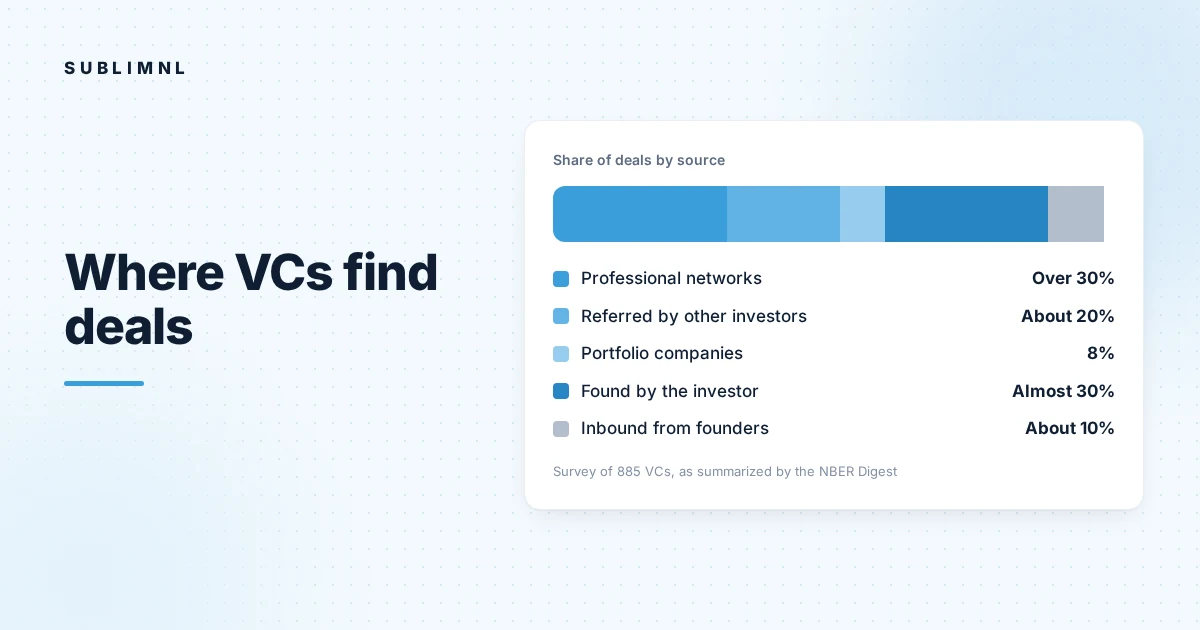
How do VCs find deals? Most founders assume the answer is "from founders emailing them." That's part of it, but a small part. In a survey of 885 venture capitalists at 681 firms, researchers at Harvard, Chicago Booth, Stanford and UBC found that only about 10% of deals arrived as inbound pitches from founders.
The rest came from somewhere else. Knowing where changes how you should spend the weeks before you send your deck.
The numbers, and where they come from
These figures come from the survey as summarized in the NBER Digest, with the authors' own summary at the Harvard Law School Forum. Our guide on finding investors for your startup cites the same source.
Here's how the surveyed VCs said their deals were sourced:
- Over 30% came through investors' professional networks.
- About 20% were referred by other investors.
- 8% came from portfolio companies.
- Almost 30% were found by the investors themselves.
- About 10% arrived as inbound pitches from founders.
Two caveats matter. The survey covers institutional VCs, not angels, so it tells you less about how an angel finds a pre-seed deal. And it's from 2016, so the exact shares may have shifted. What hasn't changed is the direction: relationships and recognition do most of the work.
What each channel means for you

The useful question isn't "how big is each slice." It's "what can I actually do about each one."
Professional networks
The largest share came through people investors already know. For a founder, that means warm introductions. Look at your list and ask who you know who knows each investor. Then ask for the intro with a short note the connector can forward unchanged. Our post on asking for a warm introduction covers how to make that easy to say yes or no to.
Referrals from other investors
Investors pass deals to each other. If an angel or a fund has already said yes, or even "too early for us, but talk to them," that referral carries weight. It's also why sending to your whole list in one tight window helps. Investors talk to each other, and a round that feels active gets more attention than one that drifts.
Portfolio companies
Founders who've already raised from a firm can introduce you to it. Founders a little ahead of you are often the warmest path you have, and many of them angel-invest too.
Self-sourced deals
Almost 30% of deals were found by the investors themselves. This is the slice founders think about least. Investors go looking. They read, they search, they notice companies in markets they care about. So being findable matters as much as being on someone's list. We cover what that looks like in practice in how to get noticed by investors.
Inbound pitches
About 10% is the smallest channel, not a closed one. A specific, short email to a partner whose recent investments match yours still works. It just works better when it isn't the first time your problem has come up.
So how do VCs find deals? Mostly through people and recognition
Put the five slices together and a pattern shows up. Nearly everything outside inbound depends on someone recognizing you: a friend of the investor, another investor, a founder in their portfolio, or the investor's own sense of what's happening in a market.
That's the practical takeaway. A cold email is the smallest channel, so let the problem get talked about before your deck arrives. Post about your market from your own accounts. Publish real company news when you have it. Ask for introductions early. Then send.
How Sublimnl fits this
Sublimnl is a fundraising outreach tool built around that order. For about two weeks before your deck lands, posts about your market go out from your own accounts. None of them name your company. In launch week, a press release goes out so an investor who looks you up finds real news. Then your deck lands in each investor's inbox with the first slides in the email, and follow-ups are drafted from what each investor read.
It can't promise who sees any particular post. The idea is simpler: the problem gets talked about first, and by the time your deck arrives, the timing already feels right. See how it works for the full sequence.
If most of your list is warm intros, you may not need a tool at all. A personal email from your own inbox is enough.
FAQ
Does this survey apply to angel investors?
Not directly. It covers institutional VCs, not angels. Angels often find deals through their own networks too, but this survey doesn't measure it.
Is cold emailing VCs worth it if only about 10% of deals come from inbound?
Yes, if the fit is real and the email is specific. It's a smaller channel, not a dead one. It works best alongside warm introductions and after your market problem has already been talked about.
What's the reply rate for cold investor emails?
There's no reliable public data on it. Anyone quoting a precise rate is guessing or describing their own users.