
How to find investors without connections: an order that works
Plenty of founders start with no network at all. No friends in venture, no previous company, no well-connected advisor. If that's you, the question of how to find investors without connections can feel like a wall. It isn't. It's a sequence, and the order matters more than the starting point.
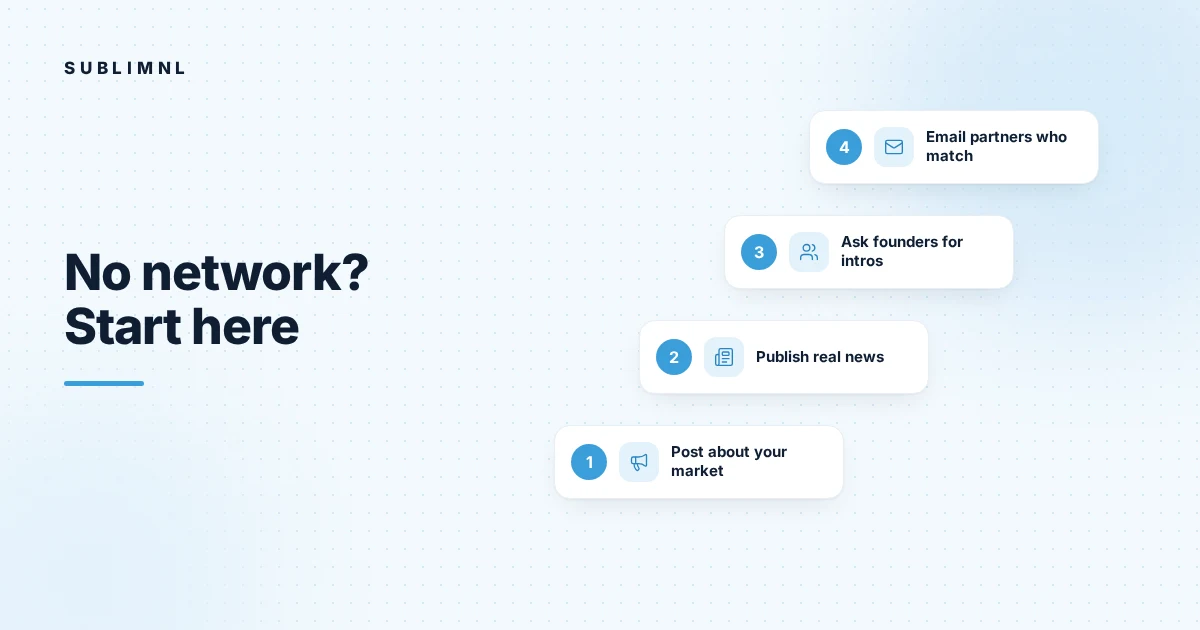
Our guide on how to find investors answers it in a few moves: make yourself findable before you email, post about your market, publish real company news when you have it, ask founders a step ahead of you for introductions, and then send short, specific emails to partners whose recent investments match yours.
Why the order matters
Most deals reach investors through people they know, and almost a third are found by investors themselves (how VCs find deals).
Two of those channels are open to you right away, even without a network. Investors go looking for deals, so you can be findable. And networks can be built, faster than most people expect, starting with founders.
Be findable before you email

Before you email anyone, an investor who searches your market, your company or your name should find something real. Post about the problem, what's changing, and why the usual fix falls short. Not your round. Publish real company news when you have it: a launch, a pilot, a meaningful hire. Keep the website plain: what you do, for whom, and how to reach you.
None of this needs connections. It needs consistency. Our post on getting noticed by investors goes deeper.
Founders a step ahead
This is how founders without networks build one. People who raised recently often angel-invest, and they can introduce you to their own investors.
You don't need to know them already. Look for founders in adjacent markets who raised in the last year or two. Start with a specific question about their raise, not a request for an introduction. Once there's a relationship, ask for an introduction, with a short note they can forward. Our post on asking founders who just raised covers how.
A short list, then a specific email
While you're building visibility, build the list. Work backward from companies like yours and note who led. The investor list is one place to start, and our guide on early-stage VC firms is the fit check for a fund. Confirm each firm on its own site. Cut anything that doesn't fit your stage, sector or region.
A short list matters more when you don't have connections, because every email has to count. At most firms, one partner covers your sector. Read what they've written and what they've backed. That tells you what the first line should be about. Our post on pitching the right VC partner is about that person.
Then send. One line on what you do, one line of real proof, the ask, and the deck, plus a line on why that partner. One email per investor, in one tight window rather than over months. By then you're not entirely cold. The problem you solve has been talked about, and some names may have come through a founder.
What to skip
A large, untargeted list is a longer list of no's, and it burns first impressions. Be wary of anyone selling access to investors. And don't announce the raise publicly before checking with your lawyer. Posting about your market is different from advertising the offering.
Every conversation adds to your network. An investor who passes may introduce you to someone else. A founder who helped you may become an angel. By your next round, you won't be starting from zero.
The full playbook is inside Sublimnl. This page is the order: be findable, talk to founders a step ahead, then write to the partners who fit.
FAQ
Can I raise money without a network?
Yes. Become findable by posting about your market, build relationships with founders a step ahead of you, and send short, specific emails to partners whose investments match yours.
Should I cold email VCs if I have no connections?
Yes, if the fit is real and the email is specific. It works best after you've built some visibility and asked founders for introductions where you can.
How do first-time founders meet investors?
Often through other founders. People who raised recently can introduce you to their investors, and many invest as angels themselves.