
BlogAngels
Are accelerators worth it? A plain way to weigh the terms
Ask a room of founders whether accelerators are worth it and you'll hear strong opinions both ways. Most of them are describing one accelerator, at one moment, for one company. The honest answer to "are accelerators worth it" is that it depends on two things you can compare: what the program takes, and what it gives you.
Our guide on finding investors for your startup puts it in one sentence: accelerators invest early and introduce you to investors at demo day, so weigh the terms against the network you'd get. This post is a framework for doing that weighing.
What an accelerator usually offers
Programs differ a lot, but most combine some of the following.
- An early investment. Many accelerators invest a set amount on standard terms. For some pre-seed companies, that's the first outside money.
- A cohort and a schedule. A fixed program with deadlines tends to force progress.
- Mentors and advisors. Quality varies widely by program.
- Demo day. A day when the cohort presents to investors, and often a run of introductions around it.
- A network after the program. Alumni, mentors and investors who keep taking your calls.
What it costs you

The cost is mostly equity, plus time.
Read the actual terms. How much does the program invest, and what does it receive in return? Is it a SAFE, a note or shares? Are there extra fees, or rights the program keeps in later rounds? Our pre-seed guide suggests comparing a SAFE's cap and discount with your lawyer and modelling the dilution before you sign. That applies here too.
Time is the other cost. A program takes weeks or months of your attention. If you're already selling well and your next step is clear, that time may be better spent on customers.
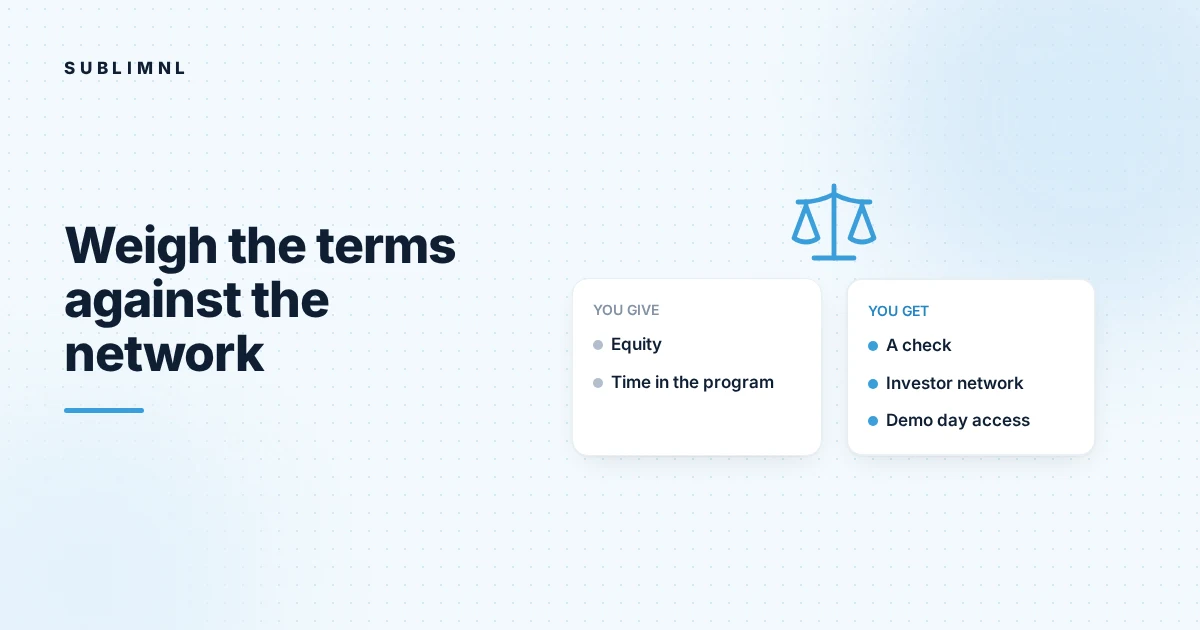
Are accelerators worth it for you? Weigh the terms against the network
Here's a simple way to compare. Write two columns.
What you give: the equity, any fees or extra rights, and your time.
What you get: the cash, the introductions you'd realistically get, and the help you'd realistically use.
The word "realistically" matters. A list of famous mentors means little if you'll only see them once. A strong demo day means little if the investors attending don't invest in your sector. Ask alumni, ideally ones in a market like yours, what they actually got.
Questions worth asking any program
- Which investors came to the last demo day, and how many of them invest at my stage and in my sector?
- What share of recent companies raised a round soon after the program? Ask for the source if they give you a number.
- Who would I actually work with week to week?
- What exactly are the terms, including any rights in future rounds?
- Can I talk to a few alumni from companies like mine?
A good program will answer all of these without fuss.
Accelerator vs angel round
The alternative to an accelerator is often a small angel round on similar early terms. Compare them directly.
An angel round gives you money and, if you choose well, operators who know your market. It doesn't give you a cohort, a schedule or a demo day. An accelerator gives you structure and access, but its terms are usually fixed and its network is broad rather than deep in your sector.
Neither is better in general. The right choice depends on what's missing for you. If you lack investor access and structure, a program can fill both gaps. If you already have a warm path to good angels, you may not need one.
Where an accelerator fits in your round
At pre-seed, an accelerator can be the investor that goes first. Our guide lists accelerators alongside angels and pre-seed funds as common leads at that stage. Read who leads at pre-seed and seed for more on why that role matters.
Even if a program invests, you'll often raise more around demo day. Treat demo day like any send: build your list beforehand, check each investor against your stage, sector and region, and follow up on what each one actually responds to.
When to skip it
If your round is coming mostly from people who already know you, or the terms take more than the access is worth to you, skip it. There's no penalty for raising without one.
FAQ
Do accelerators take equity?
Most do, in exchange for an investment and the program. Terms vary, so read them closely and compare them with your lawyer before you sign.
Is demo day enough to raise a round?
Sometimes it helps a lot, but it's not guaranteed. Prepare a list of fitting investors before demo day and follow up with them directly afterward.
Can an accelerator lead my pre-seed round?
It can. At pre-seed the lead is often an angel, a pre-seed fund or an accelerator. Check whether the program's investment is meant to anchor a round or sit alongside one.